An Ulster Line
The Ulster-American Presidents
Twenty presidents of the United States — from the seventh to the forty-third — whose ancestral roots reach back to the hills, ports and parishes of Ulster.
7
7th President

Andrew Jackson
Boneybefore, Carrickfergus, Co. Antrim
Both parents emigrated from Ulster
Both of Jackson's parents were born in Ulster and emigrated from the Carrickfergus area to the American colonies in 1765. Today, the ancestral cottage at Boneybefore stands as a lasting reminder of the family origins of America's seventh President. From those modest beginnings, Jackson rose to become a war hero, founder of the modern Democratic Party, and one of the most influential Presidents in United States history.
11
11th President

James Knox Polk
Lifford, Co. Donegal
Great-great grandfather from Donegal and Londonderry
Polk's great-great-grandfather emigrated from the Lifford area of County Donegal, close to the border with County Londonderry. During a single term in office, Polk added more territory to the United States than any President except Thomas Jefferson, helping shape the continental nation we know today.
15
15th President

James Buchanan
Omagh, Co. Tyrone
Parents from Donegal and Tyrone
Buchanan's father emigrated from Ramelton, County Donegal, while his mother traced her roots to County Tyrone. One of only three Presidents with a parent born in Ireland, Buchanan became the only President of Ulster parentage born to two Ulster-born parents. He served during the turbulent years immediately preceding the American Civil War, a period that tested the Union as never before.
17
17th President

Andrew Johnson
Mounthill, Larne, Co. Antrim
Grandfather emigrated c. 1760
Johnson's grandfather is believed to have emigrated from Mounthill, near Larne, County Antrim, around 1760. Thrust into the Presidency following the assassination of Abraham Lincoln in April 1865, he led the nation through the early years of Reconstruction as the United States sought to reunite after the Civil War.
18
18th President

Ulysses S. Grant
Ballygawley, Co. Tyrone
Grant's great-grandfather, John Simpson, left Ballygawley for America in 1760.
The Grant ancestral homestead outside Ballygawley still stands today and is open to visitors throughout the year. Grant later became the first sitting President of the United States to visit Ireland, returning to that Ulster homestead from which his family had emigrated.
21
21st President

Chester Alan Arthur
Cullybackey, Co. Antrim
Father emigrated from Antrim in 1815
Arthur's father, the Rev. William Arthur, emigrated from Cullybackey, County Antrim, to North America in 1815. One of only three Presidents with a parent born in Ireland, Arthur succeeded to the Presidency following the assassination of James A. Garfield in 1881. Though initially underestimated, he surprised many by championing civil service reform and helping modernise the federal government.
22
22nd President

Grover Cleveland
Co. Antrim
Grandfather from Antrim
Cleveland's grandfather emigrated from County Antrim to America. The only President ever elected to two non-consecutive terms, he remains both the 22nd and 24th President of the United States. His reputation for personal integrity and fiscal discipline earned him the nickname "The Veto President" and made him one of the most distinctive figures in American political history.
23
23rd President

Benjamin Harrison
Co. Antrim
Great-grandfather from Antrim
Harrison traced his ancestry to County Antrim through his great-grandfather, who emigrated from Ulster to America. Grandson of President William Henry Harrison, he served as the 23rd President of the United States and presided over a period of rapid industrial growth, expanding America's naval power and admitting six new states to the Union. He remains the only President whose grandfather was also President.
25
25th President

William McKinley
Ballymoney, Co. Antrim
Grandfather from Ballymoney
McKinley's grandfather emigrated from Ballymoney, County Antrim. His presidency marked America's emergence as a global power following victory in the Spanish-American War. Under his leadership, the United States acquired Puerto Rico, Guam and the Philippines. Assassinated in Buffalo, New York, in 1901, his death elevated Theodore Roosevelt to the Presidency.
26
26th President

Theodore Roosevelt
Larne, Co. Antrim
Maternal ancestors believed to hail from Larne
Roosevelt traced part of his maternal ancestry to the Larne area of County Antrim. Soldier, statesman, conservationist and reformer, he transformed the modern Presidency, championed the construction of the Panama Canal, expanded America's global influence and became one of the most admired figures in American political history.
28
28th President

Woodrow Wilson
Strabane, Co. Tyrone
Paternal grandfather from Strabane
Wilson's paternal grandfather came from Strabane, County Tyrone. The son of a Presbyterian minister, Wilson guided America through the First World War and became one of the most influential international statesmen of the twentieth century through his vision for the League of Nations.
33
33rd President
.jpg?width=320)
Harry S. Truman
Co. Donegal & Co. Tyrone
Ancestors from Donegal and Tyrone
Truman traced ancestry to families from Counties Donegal and Tyrone. Few Presidents have faced greater responsibilities. He led the United States through the closing stages of the Second World War, authorised the use of atomic weapons against Japan, oversaw the creation of NATO and the Marshall Plan, and helped shape the international order that defined the second half of the twentieth century.
35
35th President

John F. Kennedy
Co. Fermanagh (among others)
Great-grandparents from Limerick, Wexford, Cork, Clare and Fermanagh
Widely regarded as America's quintessential Irish President, Kennedy's ancestry spanned several Irish counties, including Wexford, Cork, Clare, Limerick and Fermanagh. His heritage serves as a reminder that the story of Irish America — like the story of Ulster itself — is often broader and more interconnected than modern boundaries suggest.
37
37th President
.jpg?width=320)
Richard Nixon
Co. Kildare & Co. Antrim
Milhous family from Kildare; Presbyterian ancestors from Carrickfergus and Ballymoney
Nixon's ancestry reflected several strands of the Irish story. His mother, Hannah Milhous Nixon, descended from the Milhous family, Irish Quakers whose roots lay in County Kildare. Through other family lines, Nixon traced Presbyterian ancestry to County Antrim, including families from Carrickfergus and Ballymoney who emigrated to America around 1753. Together, these connections linked the future President to both the Ulster and wider Irish traditions that helped shape early America.
38
38th President
.jpg?width=320)
Gerald Ford
Co. Armagh & Co. Down
Great (×4) grandparents from Armagh and Down
Ford traced part of his ancestry to families from Counties Armagh and Down. Assuming the Presidency following the resignation of Richard Nixon, he helped restore confidence in American institutions during a period of political uncertainty and guided the nation through the aftermath of Watergate.
39
39th President
.jpg?width=320)
Jimmy Carter
Co. Antrim
Great (×4) grandparents from Antrim
Carter's family roots include ancestors from County Antrim. Following his presidency, he became one of the most influential former Presidents in American history, dedicating decades to humanitarian work, election monitoring and international peacebuilding.
40
40th President

Ronald Reagan
Co. Antrim & Co. Tipperary
Great-grandparents from Antrim and Tipperary
Reagan traced family roots to County Antrim and County Tipperary. His leadership during the final decade of the Cold War, together with his enduring partnership with Speaker Tip O'Neill—another son of Irish America—demonstrated how strong convictions and personal friendship can coexist in public life.
41
41st President

George H. W. Bush
Co. Down
Great (×4) grandparents from Down
The Bush family traces part of its ancestry to County Down. George H.W. Bush served as the 41st President of the United States and played a pivotal role in supporting the Northern Ireland peace process during the years leading to the Belfast (Good Friday) Agreement.
42
42nd President

William J. Clinton
Clinton, Co. Fermanagh
Paternal line from Fermanagh
The Clinton family traces its origins to County Fermanagh, from which the family name is derived. More than any modern American President, Clinton became personally associated with the cause of peace and reconciliation in Northern Ireland. His appointment of Senator George Mitchell as Special Envoy and his sustained engagement helped support the negotiations that resulted in the Belfast (Good Friday) Agreement of 1998.
43
43rd President

George W. Bush
Co. Down
Great (×5) grandparents from Down
Through the Bush family line, George W. Bush shares ancestral roots in County Down. Following in the footsteps of his father and President Clinton, Bush maintained America's long-standing engagement in Northern Ireland, helping to advance implementation of the Belfast (Good Friday) Agreement and demonstrating the continuity of U.S. support for peace and political progress.
These twenty men account for twenty-one Presidential administrations, as Grover Cleveland served two non-consecutive terms as both the 22nd and 24th President.
20 Presidents. 21 Administrations. More than two out of every five Presidents of the United States trace family roots to Ulster.
Ulster on the Greenbacks
Presidents on U.S. Currency
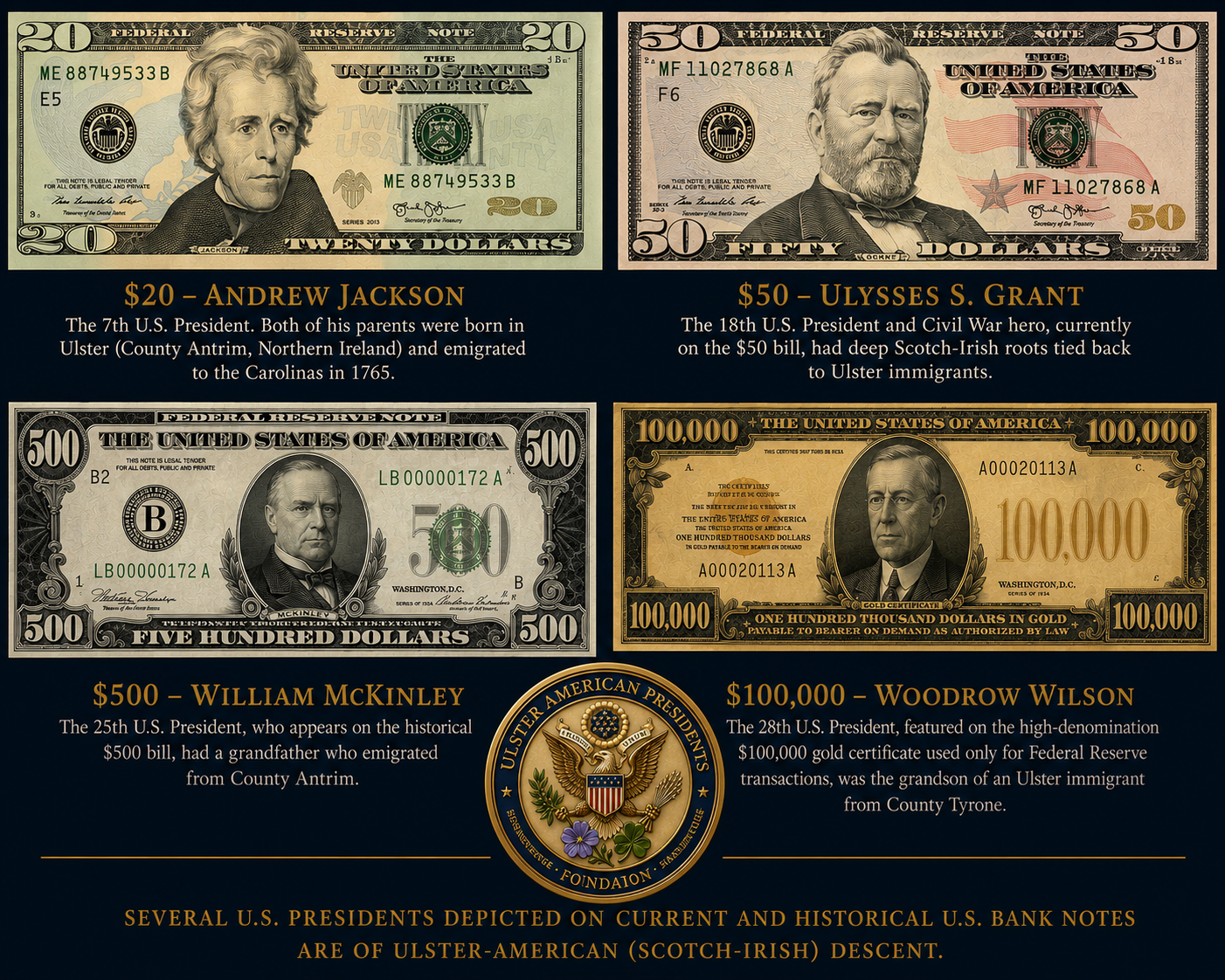
Several U.S. Presidents depicted on current and historical U.S. bank notes are of Ulster-American (Scotch-Irish) descent. These prominent figures include Andrew Jackson ($20 bill), Ulysses S. Grant ($50 bill), William McKinley ($500 bill), and Woodrow Wilson ($100,000 gold certificate).
Andrew Jackson — $20 Bill
The 7th U.S. President is prominently featured on current $20 bills. Both of his parents were born in Ulster (County Antrim, Northern Ireland) and emigrated to the Carolinas in 1765.
Ulysses S. Grant — $50 Bill
The 18th U.S. President and Civil War hero, currently on the $50 bill, had deep Scotch-Irish roots tied back to Ulster immigrants.
William McKinley — $500 Bill
The 25th President, who appears on the historical $500 bill, had a grandfather who emigrated from County Antrim.
Woodrow Wilson — $100,000 Gold Certificate
The 28th President, featured on the high-denomination $100,000 gold certificate used only for Federal Reserve transactions, was the grandson of an Ulster immigrant from County Tyrone.
A Second Line of Liberty
The Ulster-American Vice Presidents
Beyond the twenty Presidents, a further line of U.S. Vice Presidents — from John C. Calhoun in 1825 to J. D. Vance two centuries later — carried Ulster Scots lineage into the second highest office of the Republic without afterwards being elected to the Presidency in their own right.
7
7th Vice President
John C. Calhoun
Co. Donegal
Calhoun family of Donegal stock
Vice President under John Quincy Adams and Andrew Jackson; one of the most consequential statesmen of the antebellum era.
14
14th Vice President
John C. Breckinridge
Co. Antrim (via Scotland)
Breckinridge family from Scotland to Antrim, then to the American colonies in the 1700s
Great-great-grandfather Alexander Breckenridge settled in Virginia after a sojourn in Ulster. Served as Vice President under James Buchanan.
23
23rd Vice President
Adlai E. Stevenson
Ulster (via Kentucky)
Scots-Irish; ancestors emigrated from Ulster to the American colonies prior to the Revolutionary War
Vice President under Grover Cleveland (second term). Grandfather of the twentieth-century statesman of the same name.
33
33rd Vice President
Henry A. Wallace
Ulster (via Pennsylvania)
Scots-Irish Presbyterian; forebears emigrated from Ulster to Pennsylvania
Vice President under Franklin D. Roosevelt (1941–1945); later U.S. Secretary of Commerce and Secretary of Agriculture.
35
35th Vice President
Alben W. Barkley
Ulster (paternal line)
Scots-Irish Presbyterian paternal ancestry
Vice President under Harry S. Truman (1949–1953); long-serving Senate Majority Leader before that.
41
41st Vice President
Nelson A. Rockefeller
Mixed; partly Ulster
Primarily English and German, with Scots-Irish ancestry on one line
Vice President under Gerald Ford (1974–1977); long-serving Governor of New York.
45
45th Vice President
Al Gore
Ulster (via Virginia & Tennessee)
Scots-Irish; the Gore family settled first in Virginia, then moved to Tennessee after the Revolutionary War
Vice President under Bill Clinton (1993–2001). Both Clinton and Gore therefore bring Ulster lineage to the same administration.
50
50th Vice President
J. D. Vance
Co. Antrim (Presbyterian line)
Scots-Irish 'hillbilly' heritage; family ties to the same Co. Antrim Presbyterian congregation as Andrew Jackson's mother and many Carolina settlers
Vice President under Donald J. Trump from 2025. Though now a practising Catholic, Vance has visited the ancestral Co. Antrim church associated with his family's emigration.
A Wider, Deeper Lens
The ancient seafaring highway between Ulster and America.
For centuries, history books have forced the story of the Ulster-Scots into a narrow box — defined strictly by seventeenth-century politics and religious dividing lines. We look at history through a wider, deeper lens.
When we speak of the Ulster-Scots, we are not talking about a modern political invention. We are talking about something older, longer, and permanently etched into the landscape — an ancient, seafaring people who turned the narrow sea between the cliffs of Antrim, the hills of Donegal, and the coast of Argyll not into a frontier, but into a high road.
This site is dedicated to the American presidents and leaders who carried that northern spirit across the Atlantic. From the rugged populism of Andrew Jackson to the historic partnership of Ronald Reagan and Tip O'Neill, these leaders were shaped by a culture born of the ancient Scoti — the northern tribes who knew that blood, water, and storytelling run deeper than any border.
The Reagan & O'Neill Partnership
The Convergence of the North Channel in the Oval Office
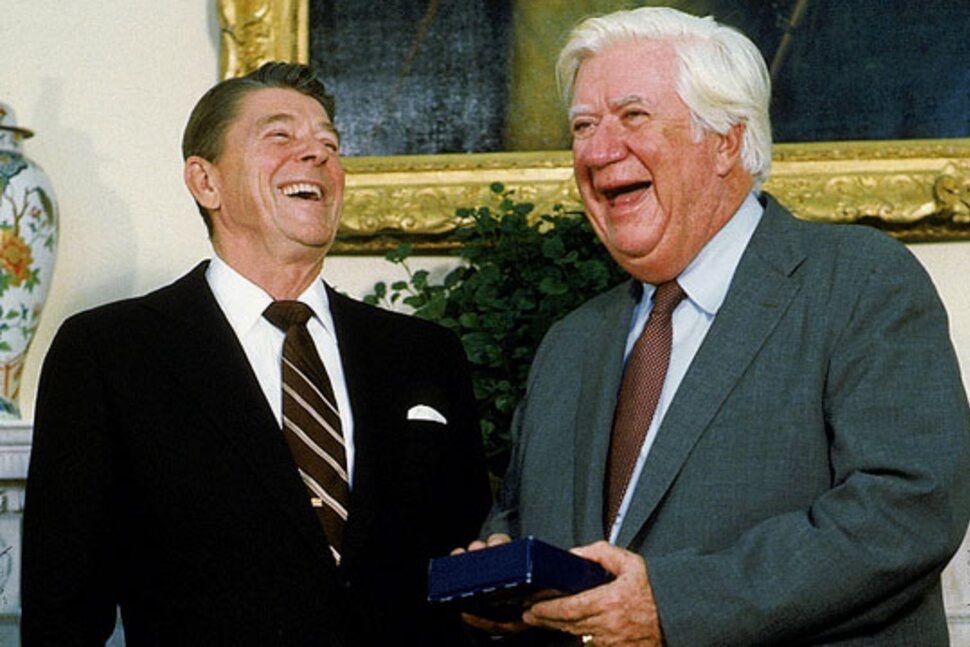
Perhaps no relationship in modern American political history better embodies the unbroken continuum of the Ulster thesis than the partnership between President Ronald Reagan and Speaker of the House Tip O'Neill.
To the casual observer, they were political polar opposites: a Western conservative and a New England liberal; a Protestant with frontier roots and a devout Irish Catholic whose maternal family hailed from Buncrana, County Donegal — in the historic province of Ulster. But look closer, and you see the ancient seafaring highway at work.
When Reagan and O'Neill sat down after six o'clock to swap stories, debate fiercely, and ultimately forge compromises that moved a nation forward, they were channelling a shared cultural DNA. Both men possessed the egalitarian, plain-spoken and fiercely independent streak native to the north of Ireland. Neither bowed to elites. Both ruled through the deeply personal loyalty of the clan system. Both shared the sharp, anti-pretentious wit of their ancestors.
By honouring Speaker O'Neill alongside President Reagan, we close the full circle of the Ulster-American story: two giants who clashed, cooperated, and ultimately used their shared heritage to help bring lasting peace back to the very northern hills their ancestors left behind.