1607
Jamestown, Virginia is founded as the first permanent English settlement. Simultaneously, across the Atlantic, King James I initiates the Plantation of Ulster, settling Scottish Presbyterians in the north of Ireland to secure the region.
Heritage & Identity
On July 4, 2026, the United States of America turns two hundred and fifty years old. This site marks the Semiquincentennial by remembering one of the founding's most remarkable — and most quietly told — stories: the part played by the people of Ulster.
The original Declaration of Independence was written in the hand of an Ulster Scot, first printed by another, first read in public by the son of a third, and first signed by a man whose people came from County Down. In the centuries that followed, twenty presidents of the United States — from Andrew Jackson to George W. Bush — carried Ulster blood to the White House.
The story did not end with the Declaration of Independence, nor with the election of twenty Presidents of Ulster heritage.
Across the centuries, Ulster and America have remained connected through migration, commerce, innovation, public service and shared sacrifice.
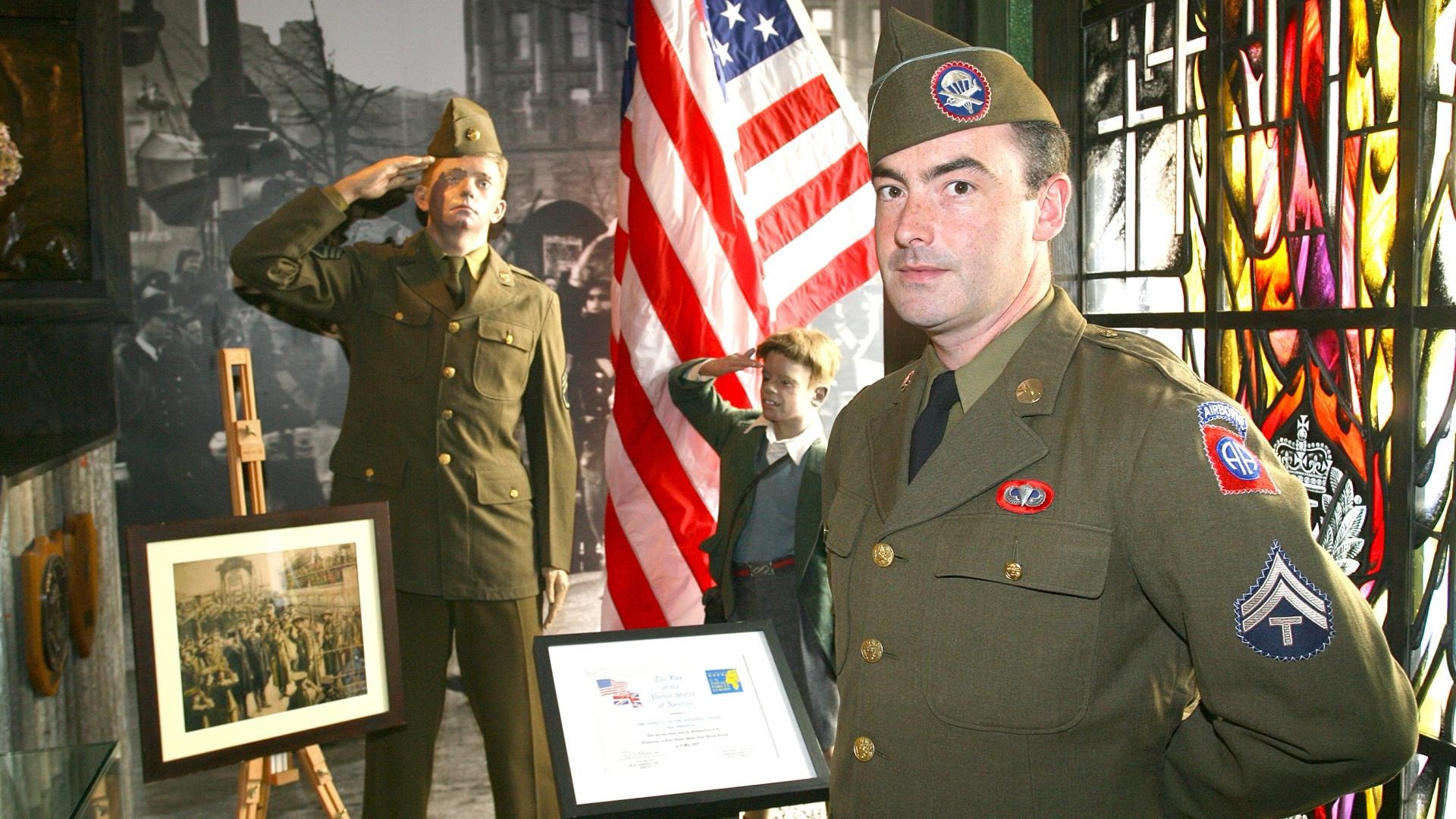
During the Second World War, hundreds of thousands of American servicemen and women passed through or were stationed in Northern Ireland as the United States prepared for the liberation of Europe. Belfast became one of the principal gateways to the European Theatre of Operations, while communities across Ulster welcomed American troops who would soon depart for Normandy and beyond.
General Dwight D. Eisenhower inspecting American troops in Northern Ireland, May 1944.
In May 1944, General Dwight D. Eisenhower, Supreme Allied Commander and future President of the United States, visited Northern Ireland to inspect American forces preparing for D-Day. Following the war, he returned to Belfast to receive the Freedom of the City — a symbol of the friendship forged between Ulster and America during those decisive years.
The same shores from which generations of emigrants departed for America later welcomed American troops returning in friendship and common cause.
The story of the Ulster-Americans is therefore not simply a story of origins. It is the story of an enduring relationship — strengthened through generations of shared endeavour, service and sacrifice, and carried forward by those who continue to build bridges across the Atlantic today.
A Note on Names
The island of Ireland is traditionally divided into four ancient provinces: Ulster, Leinster, Munster and Connacht. Ulster comprises nine counties: the six counties of Northern Ireland and the counties of Donegal, Cavan and Monaghan.
Many of the individuals featured on this website trace their family origins to Ulster. Some came from what is today Northern Ireland; others came from counties that now form part of the Republic of Ireland. All left long before partition and the creation of Northern Ireland in 1921.
For that reason, we use the term Ulster-American as a historical and geographical description rather than a political one. It reflects the province from which these families came and acknowledges the rich diversity of traditions that contributed to the migration from Ulster to North America.
The Ulster-American story includes Presbyterians, Anglicans, Methodists and Catholics; Ulster-Scots, English, Huguenot and Gaelic Irish families; merchants, farmers, ministers, labourers, industrialists, innovators and pioneers. Together they helped shape communities across the United States and contributed significantly to the American story.
The term is intended to unite rather than divide, recognising a heritage that transcends modern political boundaries and belongs to all who share in this story.
We use the term Ulster-American in that broad and inclusive spirit.
Like the intertwined shamrock and flax flower in our emblem, it recognises a shared inheritance shaped by many traditions, many journeys, and a continuing friendship between Ulster and the United States.
A NOTE ON KINSHIP
Visitors to this website will encounter both the terms Ulster-Scots and Scots-Irish.
In the United States, descendants of migrants from Ulster are most commonly described as Scots-Irish. In Ulster itself, the term Ulster-Scots is more frequently used. Both terms describe closely related communities and traditions, viewed from different sides of the Atlantic.
The story, however, stretches back long before the great migrations to America and long before the seventeenth-century Plantation of Ulster. For centuries, the narrow sea between north-east Ireland and western Scotland connected rather than divided the peoples who lived along its shores.
In the early medieval period, the kingdom of Dál Riata (Dalriada) extended across parts of present-day County Antrim and Argyll. Its inhabitants, known as Gaels, formed part of a shared maritime culture linked by trade, travel, language, faith and family connections. The Latin term Scoti, used by Roman writers to describe Gaelic peoples from Ireland, is widely believed to have given Scotland its name.
Over many centuries, successive movements of people between Ulster and Scotland helped shape the cultural traditions that later became associated with both the Ulster-Scots and the Scots-Irish experience.
When Americans speak of the Scots-Irish, they are often describing the descendants of those who crossed the Atlantic from Ulster. When we speak of the Ulster-Scots, we recognise a wider historical and cultural story that reaches back through many generations and across both shores of the North Channel.
This website uses both terms respectfully and recognises them as part of a shared story that links Ulster, Scotland and the United States.
The Emblem
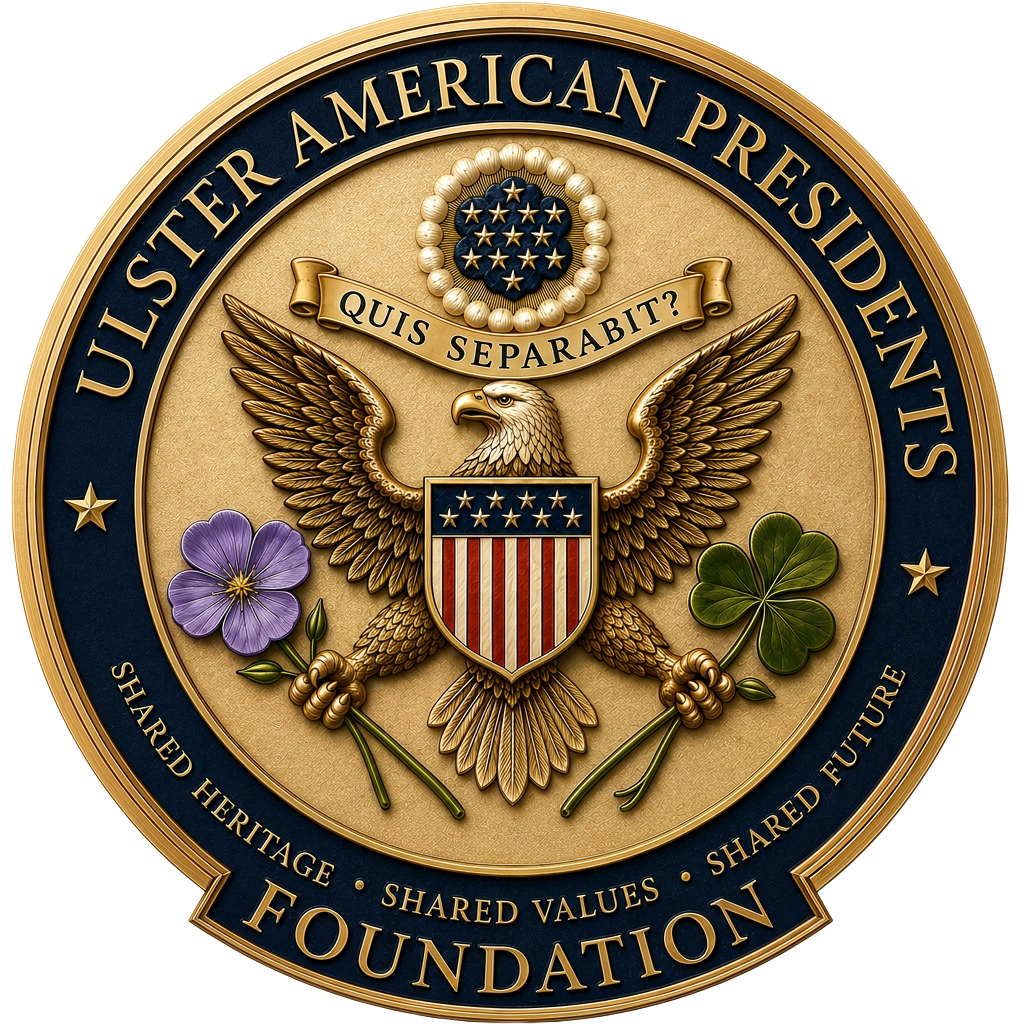
The emblem of the proposed Ulster-American Presidents Foundation weaves together several symbols that tell a shared story stretching across centuries and across the Atlantic.
At its heart stands the American Eagle, drawn from the Great Seal of the United States. The Great Seal was designed under the leadership of Charles Thomson of Maghera, County Londonderry, the long-serving Secretary of the Continental Congress. Thomson not only attested the Declaration of Independence but helped shape many of the symbols through which the young Republic would present itself to the world. The eagle therefore represents liberty, self-government, civic responsibility, and the enduring friendship between Ulster and America.
The Foundation's emblem uses elements of Ulsterman Charles Thomson's design of the Great Seal, but removes America's Latin motto E Pluribus Unum — Out of Many One — and adopts the Ulster Latin motto Quis Separabit?, which derives from Romans 8:35 and here appropriately suggests, “Who Can Separate Us?” — Ulster and America with our shared history.
Still, the eagle is protected by the shield with thirteen red and white stripes, and the emblem is topped by the constellation of thirteen stars, denoting not only the thirteen original colonies of the United States, but also Ulster's involvement in the formation of the nation from its very inception.
Rather than carrying an olive branch and a quiver of arrows, our eagle carries the flax flower and shamrock — illustrative of Ulster's rich heritage.
The shamrock recalls the tradition of Patrick, who is said to have plucked the three-leafed plant from the soil of County Down to illustrate the mystery of the Holy Trinity: Father, Son, and Holy Spirit. Long before later political and religious divisions emerged, Patrick's teaching formed part of the common Christian inheritance of the people of Ireland. The shamrock therefore speaks not only of faith, but also of unity, shared origins, and a heritage that belongs to all.
Alongside it stands the flax flower, symbol of the linen industry that transformed Ulster and helped build the prosperity of Belfast and the wider province. The flax plant and the skills required to cultivate and weave it were advanced by Huguenot refugees who sought sanctuary from religious persecution in Europe. Their contribution helped establish Ulster's reputation for craftsmanship, innovation, enterprise, and international trade.
The flax flower was later incorporated into the emblem of the Northern Ireland Assembly established following the Belfast (Good Friday) Agreement, where it serves as a symbol of a society seeking reconciliation, partnership, and a shared future.
Together, the shamrock and flax flower first appeared in the Northern Irish Connections mark, developed following the Northern Ireland Global Diaspora Strategy of 2011. Their inclusion here acknowledges that the story of Ulster's relationship with America belongs to the whole community and to all those who have contributed to it.
The emblem also reflects a wider historical truth. Many of the people who carried the Ulster story to America carried both faith and skill. Presbyterian settlers, Anglican families, Catholic migrants, Huguenot refugees, merchants, craftsmen, farmers, soldiers, ministers, educators, and entrepreneurs all played a part in building the transatlantic relationship that endures to this day.
Together they tell a story of a people whose influence reached far beyond their shores and whose legacy continues to strengthen the bonds between Ulster and the United States.
From Boneybefore to the Oval Office, from Strabane to the printing press of independence, this is a shared inheritance worth telling.
A Transatlantic Timeline
The timeline of early America is deeply intertwined with the story of the Ulster-Scots — the Scots-Irish — whose migration transformed the frontier, drove the linen and commodity trades, and supplied the fierce martial spirit that fuelled the War of Independence.
Phase I
Late 1500s – 1600s
1607
Jamestown, Virginia is founded as the first permanent English settlement. Simultaneously, across the Atlantic, King James I initiates the Plantation of Ulster, settling Scottish Presbyterians in the north of Ireland to secure the region.
1620
The Pilgrims land at Plymouth, Massachusetts. Over the following decades, basic colonial trade routes emerge between the colonies and the British Isles.
1670
Charlestown (Charleston), South Carolina is established. It quickly becomes the wealthy economic hub of the Southern colonies, operating strictly under British mercantile laws that prioritise cash crops over manufacturing.
Phase II
1717 – 1770
1717
The first wave of Ulster migration begins. Hit by rack-renting, crop failures, and religious discrimination under the Test Act, thousands of Ulster-Scots depart for America, initially arriving in Boston.
1718
Rev. James McGregor of Aghadowey, County Londonderry, leads a substantial group of Ulster families from the Bann Valley to New England aboard five ships. Settling at what became Londonderry, New Hampshire, McGregor serves as founding minister, representing the transition from Ulster as a place people left to Ulster as a people who helped build America.
1720s–1730s
The influx grows. Commodity traders and linen merchants in Belfast and Derry organise shipping networks: ships carrying American flaxseed across the Atlantic return to Ulster packed with immigrants. Ulster-Scots settle the Pennsylvania frontier, introducing a fierce, independent borderland culture.
1740s
Early pioneer families, including the Crocketts and Houstons, arrive during this era. Finding Pennsylvania increasingly crowded, they begin moving down the Great Wagon Road through the Shenandoah Valley of Virginia into North Carolina's Piedmont region.
1760s
The Southern backcountry explodes with growth. While wealthy Lowcountry families in Charleston control the profitable rice and indigo trade, Ulster-Scots and assimilated Huguenot refugees settle the rural Upcountry, cultivating flax as a necessity for homespun linen clothing.
Phase III
1771 – 1775
1771–1772
Lord Donegall, a vast landlord in County Antrim, mass-evicts tenant farmers to secure higher rents, sparking widespread agrarian outrage — the “Hearts of Steel” movement.
August–October 1772
In a defining moment of organised migration, Reverend William Martin, a Covenanter minister from Kellswater, County Antrim, leads a massive exodus. He arranges a flotilla of five ships — James and Mary, Lord Dunluce, Pennsylvania Farmer, Hopewell, and Freemason — to carry over 1,000 of his congregation directly from Larne and Belfast to Charleston, South Carolina. These deeply religious, resilient tenant farmers settle the South Carolina Backcountry around Chester and Rocky Creek, bringing an intense resentment toward British rule and landlord oppression.
1774
Overwhelming numbers of Ulster-Scots populate the frontiers. Figures like Samuel Crockett serve as local justices and militia leaders on the bleeding edge of the Western frontier, preparing for conflicts such as Dunmore's War.
Phase IV
1776
28 June 1776 — Carolina Day
Just days before the Declaration of Independence, a British fleet attacks Charleston. A makeshift fort made of palmetto logs and sand on Sullivan's Island holds out under Colonel William Moultrie. Backcountry Ulster-Scots, renowned for their marksmanship, form the backbone of the continental regiments and local militias that successfully repel the British. This crucial victory prevents a Southern British occupation for several years and is celebrated annually as Carolina Day.
4 July 1776
The Declaration of Independence is adopted. The physical document is printed by John Dunlap, an Ulster-Scot immigrant from County Tyrone. The Ulster-Scots — hardened by decades of frontier life and long-standing grievances with the British Crown — flock to the Continental Army, becoming the fierce fighting force famously described by Hessian officers as the heart of the rebellion.
Phase V
1780s – 1791
1780–1781
The Backcountry becomes the vital theatre of the Revolutionary War. At the Battle of King's Mountain (1780), an army of “Overmountain Men” — largely composed of Ulster-Scots Presbyterian frontiersmen — decimates British Loyalist forces, turning the tide of the war in the South.
1783
The Treaty of Paris officially ends the War of Independence.
Mid-1780s
Post-war economic depression triggers the next great internal migration. Massive wagon trains of veterans and young families move west across the Blue Ridge Mountains. A young Sam Houston moves with his family from Virginia into Tennessee, setting up the next generation of frontier leadership.
17 September 1787
The United States Constitution is signed in Philadelphia, establishing the structural framework of the new republic.
15 December 1791
The Bill of Rights is ratified. The Ulster-Scot emphasis on religious freedom and deep-seated distrust of centralised government power heavily influences these protections, permanently etching their frontier ethos into the founding legal documents of the United States.
From the frontier cabins of the Piedmont to the Oval Office — twenty United States Presidents trace their roots to the ancient province of Ulster. Their story is the subject of this Foundation.