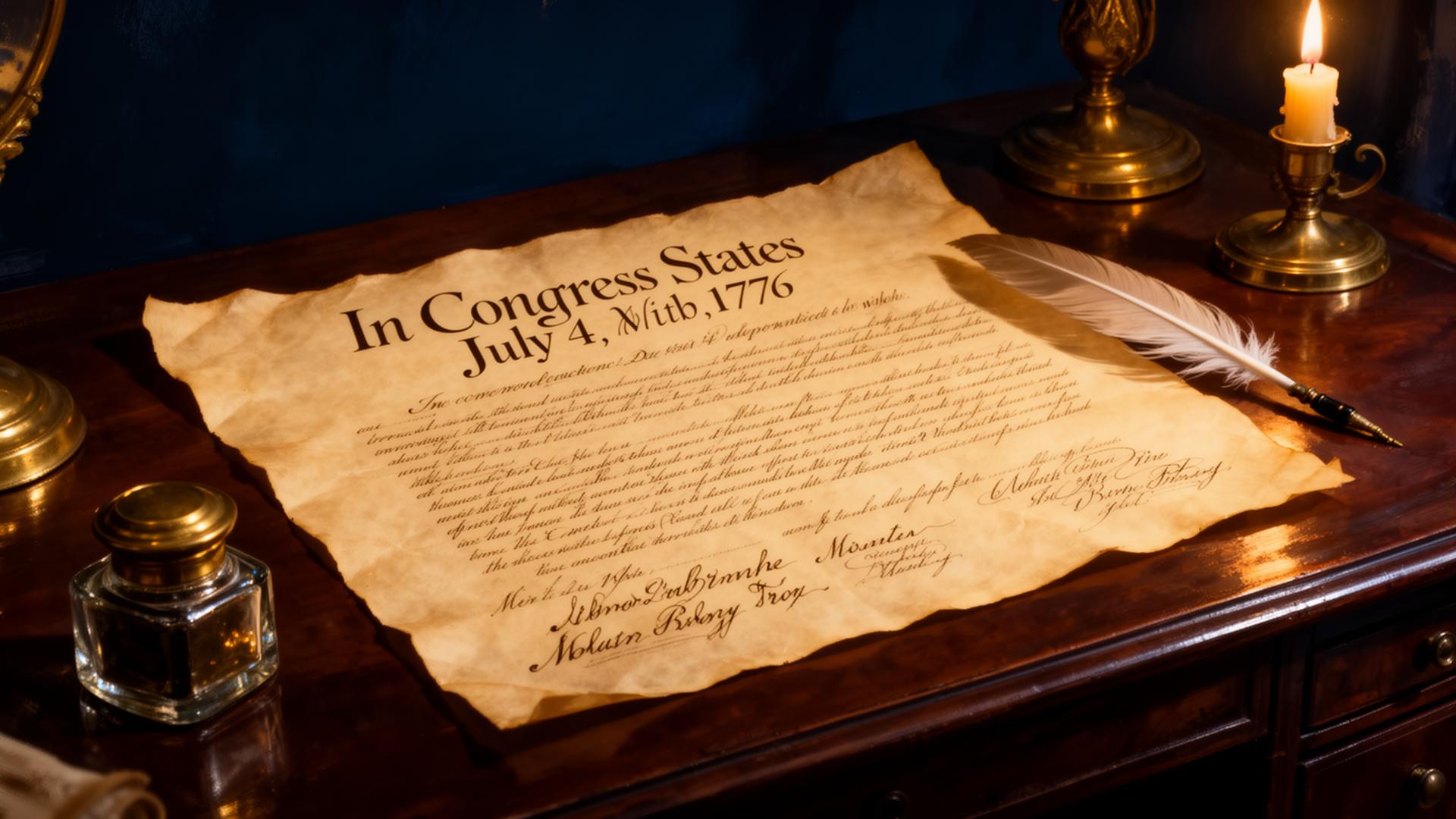
Many contend that the original Declaration of Independence is in the hand of Charles Thomson of Maghera, Secretary of the Continental Congress and one of the most influential figures of Revolutionary America. What is beyond dispute is that Thomson attested the Declaration in his capacity as Secretary of Congress, while the first printed copies were produced by John Dunlap of Strabane and the Declaration was first proclaimed publicly by Colonel John Nixon, the son of Ulster emigrants.
On 4 July 1776, the first official copy of the Declaration was authenticated by only two signatures: John Hancock, President of the Congress, whose family roots lay in County Down, and Charles Thomson of Maghera. In that remarkable moment, the founding document of the United States was authenticated by two men whose family origins were in Ulster.
✦ ✦ ✦
The Penman
Charles Thomson
Born Maghera, Co. Londonderry · Secretary of the Continental Congress
Thomson held the office of Secretary from the First Continental Congress in 1774 until the dissolution of the Confederation in 1789 — fifteen years at the centre of American independence. His was the hand that copied the engrossed Declaration; his was the second name, after Hancock's, on the very first printed broadside.
The Printer
John Dunlap
Born Strabane, Co. Tyrone · Printer to the Continental Congress
On the night of July 4, 1776, Dunlap printed the first one hundred copies of the Declaration — the celebrated 'Dunlap Broadsides'. As a young man he had served as bodyguard to General Washington at Trenton and Princeton. He later rose to Major, leading Pennsylvania's cavalry militia in helping suppress the Whiskey Rebellion of 1794.
The Herald
Colonel John Nixon
Son of an Ulster Scot emigrant · Philadelphia militia commander
On July 8, 1776, in the yard of the Pennsylvania State House, Colonel Nixon gave the Declaration its first public reading. The cheers of Philadelphia carried a charter written, printed and proclaimed almost entirely by Ulster hands.
The First Signature
John Hancock
Ancestors from County Down · President of the Continental Congress
Hancock's bold signature — the most famous on the document — was the first inscribed upon it. His family roots reached back to County Down, joining him to a long line of Ulster emigrants who would shape the young republic.
A reckoning
“The original is in the handwriting of an Ulster Scot. It was first printed by an Ulster Scot, and first read in public by the son of an Ulster Scot. The first signature was that of a man whose ancestors came from County Down.”
The Signers
Ulster around the table
✦
Of the fifty-six men who put their names to the engrossed Declaration of Independence, three were born in Ulster and a further five were Ulster-Americans of direct Ulster descent. Together with Charles Thomson — who, as Secretary of Congress, certified the text but did not sign the engrossed parchment — they form a remarkable Ulster presence at the founding of the United States.
Signers Born in Ulster
Pennsylvania · 1776
James Smith
Born in Ulster, c. 1719
Emigrated to Pennsylvania as a child with his family. Trained as a lawyer and surveyor, he raised one of the first volunteer militia companies in the colony and was a delegate to the Continental Congress when he signed the Declaration.
Pennsylvania · 1776
George Taylor
Born Co. Antrim, 1716
Arrived in the colonies as an indentured servant and rose to become a prosperous iron manufacturer in Pennsylvania, casting cannon and shot for the Continental Army. Sent to Congress in July 1776, he signed the Declaration the following month.
New Hampshire · 1776
Matthew Thornton
Born in Ulster (thought to be Derry), 1714
Emigrated with his family as a toddler. A physician, judge and President of the New Hampshire Provincial Congress, he arrived too late to vote on independence but added his signature to the engrossed Declaration in November 1776.
Additional Ulster-American Signers
Massachusetts · President of Congress
John Hancock
Family roots in County Down
The first and most famous signature on the engrossed Declaration. As President of the Continental Congress, Hancock — whose lineage traces back to County Down — also led the body that adopted and proclaimed the document.
Delaware
Thomas McKean
Parents of Ulster lineage from Co. Antrim
Lawyer, soldier and statesman who later served as President of Congress and Governor of Pennsylvania. The son of emigrants of Ulster lineage from County Antrim, he was among the last to sign the engrossed Declaration.
South Carolina
Edward Rutledge
Father a physician of Ulster lineage from Tyrone
At twenty-six, the youngest signer of the Declaration. His father, Dr John Rutledge, was a physician of Ulster lineage from County Tyrone who had emigrated to Charleston in the 1730s.
Delaware
George Read
Father Dublin-born, of Ulster lineage
A lawyer and later Chief Justice of Delaware, Read was born in Maryland to a father of Ulster lineage who had emigrated from Dublin. He helped shape both the Declaration and, later, the United States Constitution.
South Carolina
Thomas Lynch Jr.
Grandfather emigrated from Ulster
Plantation owner and Continental Army officer whose grandfather emigrated to the Carolinas from Ulster roots. He took his father's seat in Congress and signed the Declaration before being lost at sea aged just thirty.
The Certifier
Charles Thomson
Born Maghera, Co. Londonderry · Secretary of Congress
Though not a signer of the engrossed parchment, Thomson is widely believed to have written the official text and certainly certified the first printed copies. His name appeared, second only to Hancock's, on every Dunlap Broadside sent out across the new nation.