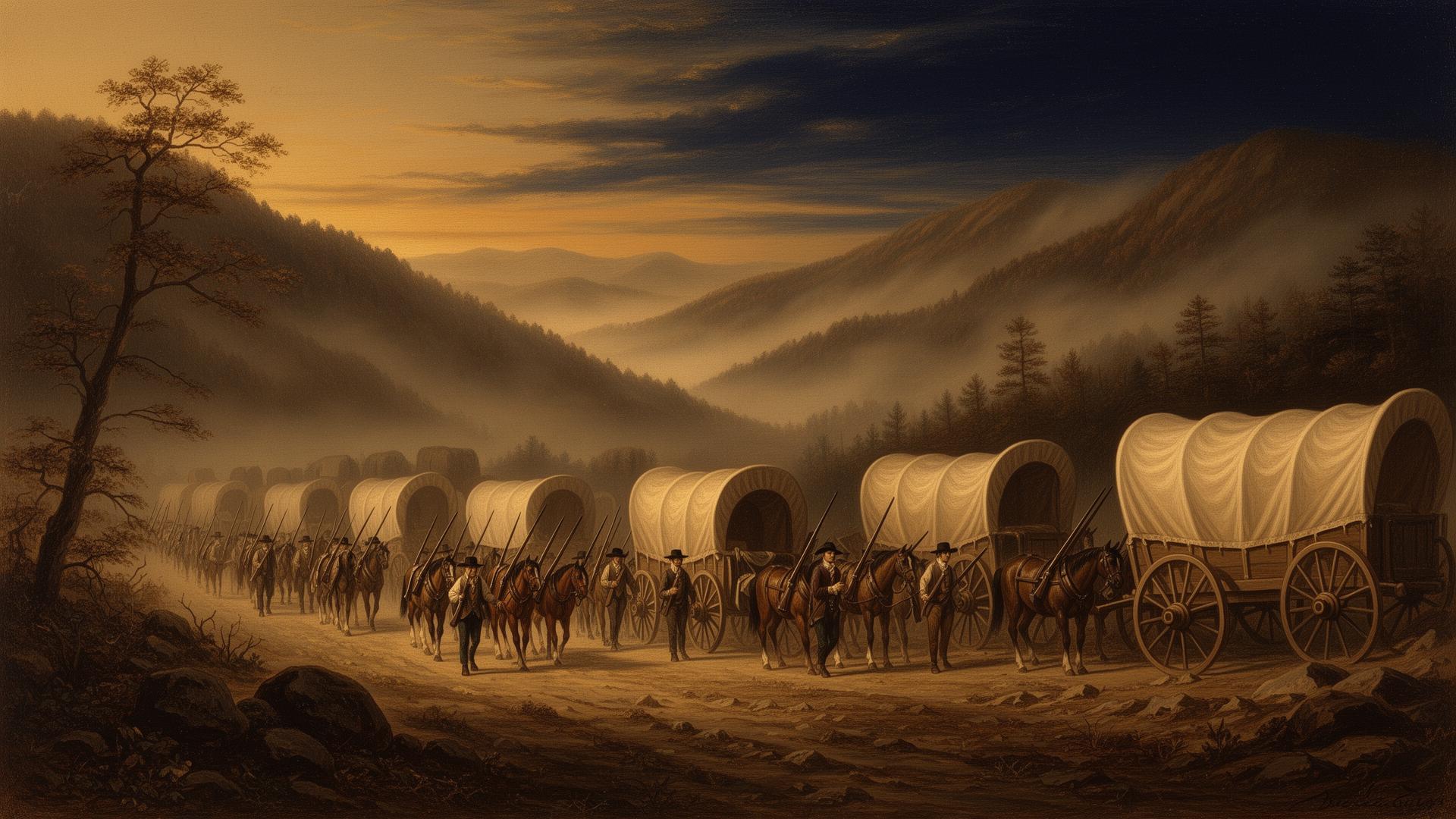
Long before the United States was born — and long after — the people of Ulster were among those who shaped its character. They walked the Wilderness Road into Kentucky, raised the cabin walls of the Appalachian valleys, signed the Mecklenburg Resolves, defended the Alamo, wrote its literature and walked on its Moon.
✦
1677 – 1729
Rev. James McGregor
Founding Minister of Londonderry, NH · Leader of the 1718 Migration
Born Aghadowey, Co. Londonderry
In 1718, Rev. James McGregor of Aghadowey led members of his congregation across the Atlantic to establish Londonderry, New Hampshire, helping inaugurate one of the great migrations that would shape the American frontier and leave an enduring Ulster imprint on the United States. As a boy, tradition holds that he participated in the defence of Derry during the Siege of Derry in 1689 and helped fire one of the cannons from the city walls. He represents the perfect transition of Ulster as a place people left to Ulster as a people who helped build America — the mountain range of families beneath the visible peaks of future presidents.
1728 – 1793
Thomas Barclay
America's first Consul to France · Negotiator of the Moroccan-American Treaty
Born Strabane, Co. Tyrone
Born in Strabane in 1728, the son of a prosperous linen merchant and ship owner, Barclay emigrated to Philadelphia in the 1760s and played a key role in the Philadelphia Tea Party of 1773. In 1781 the Continental Congress appointed him America's first consul to France, where he worked alongside Franklin and Jefferson. His greatest achievement came in 1786 when he negotiated America's first treaty with Morocco — the longest unbroken treaty relationship in U.S. history — secured without tribute or annual payments. On assignment for President Washington in 1793, he became the first American diplomat to die abroad in service to his adopted country.
1728 – 1822
John Stark
Continental Army Major General · Hero of Bennington
Son of Ulster Scots emigrants from Co. Londonderry
Stark gave the United States one of its enduring mottos — 'Live Free or Die'. He led colonial militia at Bunker Hill and won the pivotal Battle of Bennington in 1777, helping to turn the tide of the Revolution. His parents had sailed from Ulster in 1720.
1729 – 1824
Charles Thomson
Secretary of the Continental Congress, 1774–1789
Born Maghera, Co. Londonderry
Orphaned on the voyage to America when his father died at sea, Thomson rose to hold one office — Secretary of the Continental Congress — for the entirety of the Revolution. The engrossed Declaration is in his hand. His was the second name, after Hancock's, on the very first printed broadside.
1729 – 1783
William Preston
Colonel · Virginia legislator · Signatory of the Fincastle Resolutions
Born Limavady, Co. Londonderry
Colonel William Preston was a leading Ulster-Scots figure whose life bridged Ireland and early America. Born in Limavady in 1729, he grew up in a community shaped by the legacy of the Covenanters and the Siege of Derry. Emigrating to Virginia, he became a prominent landowner, militia officer, and political leader on the frontier. In 1775 he was one of fifteen signatories of the Fincastle Resolutions, an early declaration supporting American resistance. He later helped establish the town of Smithfield, and his son James Patton Preston went on to serve as Governor of Virginia.
1737 – 1824
Oliver Pollock
Merchant & Financier of the Revolution · Inventor of the Dollar Sign ($)
Born Co. Tyrone
An Ulster-born merchant from County Tyrone, Pollock emigrated to Pennsylvania in 1760. During the American Revolutionary War, he became a primary financier of the patriot cause in the West, leveraging his merchant fortune to supply Continental forces. He is historically credited with creating the U.S. dollar ($) sign in 1778, which he devised as a shorthand abbreviation 'pˢ' for the Spanish pesos he used to secure the loans that funded the struggle for independence.
1740 – 1825
Hercules Mulligan
Tailor · Sons of Liberty · Spy for George Washington
Born near Coleraine, Co. Londonderry
Born near Coleraine in 1740, Mulligan emigrated with his family to New York at age six. After attending King's College, he became a successful tailor whose shop attracted New York's elite — including British officers who had their uniforms made there. A founding member of the Sons of Liberty, he used his position to gather intelligence for General Washington, and his information is credited with saving Washington's life on two separate occasions. He is buried beside his close friend Alexander Hamilton at Trinity Church.
1747 – 1812
John Dunlap
Printer of the Declaration · Major, Pennsylvania Light Horse
Born Strabane, Co. Tyrone
Apprenticed to his uncle in Philadelphia as a boy, Dunlap printed the first 100 copies of the Declaration on the night of 4 July 1776. He served as bodyguard to General Washington at Trenton and Princeton, and rose to Major leading Pennsylvania's cavalry militia.
1751 – 1800
Henry Osborne
Georgia Chief Justice · Commissioner for Indian Affairs
Born Limavady, Co. Londonderry
Born in Limavady in 1751, Osborne emigrated to Pennsylvania in 1779 and became a lawyer, serving as judge advocate of the Pennsylvania militia during the Revolution. After moving to Georgia, he was elected to the Georgia Assembly (1786–1788), became Georgia Chief Justice in 1787, and negotiated with the Creek Nation as Commissioner for Indian Affairs. His career ended in scandal — impeached in 1790 for land speculation — but his story reflects both the opportunities and temptations faced by Ulster-Scots emigrants in the new republic.
1764 – 1834
Alexander Brown
Pioneer of Wall Street Finance · Founder of Alex. Brown & Sons
Born Ballymena, Co. Antrim
Before Wall Street became the global center of finance, Alexander Brown laid the foundations of the American investment banking system. Born in Ballymena where he worked as a successful linen merchant, he emigrated to Baltimore in 1800. Recognizing that the young republic lacked structured financial systems, he founded Alex. Brown & Sons, the nation's first investment banking firm, which organized America's very first Initial Public Offering (IPO) in 1808. His sons expanded the financial empire across the East Coast, ultimately birthing the famed merchant bank Brown Brothers Harriman.
1782 – 1850
John C. Calhoun
U.S. Vice President · Senator · Secretary of State & of War
Calhoun family from Co. Donegal
The towering — and contested — South Carolina statesman, twice Vice President of the United States, was the son of a Scots-Irish settler whose family had emigrated from Donegal to the Carolina backcountry, a heartland of Ulster settlement.
1786 – 1836
Davy Crockett
Frontiersman, Congressman, Defender of the Alamo
Ancestors from Castle Crockett, Co. Donegal, via the Ulster Scots migration
The 'King of the Wild Frontier' was the great-grandson of Ulster Scots who crossed the Atlantic in the early 1700s. Born on the Tennessee frontier, Crockett served three terms in the U.S. Congress before dying at the Alamo in 1836 — a folk hero of the American republic with Ulster blood in his veins.
1793 – 1863
Sam Houston
President of the Republic of Texas · Governor of Tennessee & Texas
Houston family from Ballyboley, Co. Antrim
The man who won Texan independence at San Jacinto and twice served as President of the Republic of Texas descended from an Ulster Scots family that emigrated to Pennsylvania and pushed south into the Virginia Valley. He stands as one of the most consequential frontier statesmen in American history.
1803 – 1891
James Gamble
Titan of Consumer Goods · Co-Founder of Procter & Gamble
Born near Enniskillen, Co. Fermanagh
James Gamble pioneered mass manufacturing and corporate branding in the United States. Born near Enniskillen to a Methodist minister, his family emigrated to America in 1819. Settling in Cincinnati, Gamble apprenticed as a soap maker. In 1837, he teamed up with his English brother-in-law, candle maker William Procter, to found Procter & Gamble (P&G). Gamble secured massive contracts to supply the Union Army during the Civil War, introducing millions to P&G products, and in 1879 helped formulate the world-famous Ivory Soap.
1809 – 1884
Cyrus McCormick
Inventor of the mechanical reaper · Industrialist
McCormick family from Co. Antrim
The Virginia-born son of Ulster Scots stock whose mechanical reaper transformed agriculture across the prairies of the New World — and the world. The McCormick Harvesting Machine Company became one of the foundations of International Harvester.
1809 – 1849
Edgar Allan Poe
Poet, Author & Literary Pioneer
Poe family roots in Dring, Co. Cavan
Widely regarded as a central figure of Romanticism and early American literature, the author of The Raven was the first well-known American writer to earn a living exclusively through writing. He pioneered the detective fiction genre and significantly shaped the emergence of science fiction. His great-great-grandfather, David Poe, was an Ulster tenant farmer from Dring, County Cavan, whose family emigrated to Pennsylvania and Baltimore around 1750.
1813 – 1908 / 1855 – 1937
Thomas & Andrew Mellon
Industrialists, Bankers & Philanthropists · US Secretary of the Treasury
Born Castletown, near Omagh, Co. Tyrone (Thomas)
Thomas Mellon was born in Castletown, Co. Tyrone, in 1813, emigrating to Pennsylvania with his family in 1818. His story reflects classic Ulster-Scots qualities: modest farming origins, an emphasis on education, deep Presbyterian values, thrift, enterprise, and public service. He became a lawyer, judge, and entrepreneur, founding the financial institution that became the Mellon banking empire, and credited his success to the upbringing and values of his Ulster heritage. His son, Andrew Mellon, became one of the most influential Americans of the 20th century. Serving as U.S. Secretary of the Treasury under three Presidents, he was a chief architect of 1920s economic policy and a founder of major corporations like Alcoa and Gulf Oil. Together, their legacy demonstrates the profound impact of Ulster faith, education, enterprise, and philanthropy on the United States, visible today in Washington, D.C., through Andrew's founding gift of the National Gallery of Art.
1817 – 1891
James McHenry
Gilded Age Railroad Tycoon & Financier
Born Larne, Co. Antrim
Born in Larne, County Antrim, McHenry became a premier Gilded Age railroad tycoon and financier. Emigrating to America, he accumulated immense wealth by funding massive transatlantic shipping networks and pioneering rail links that connected the growing American industrial heartland with European trade markets, driving the rapid expansion of 19th-century international commerce.
1824 – 1863
Stonewall Jackson
Confederate General · Tactician of the Shenandoah
Jackson family from Coleraine, Co. Londonderry
Whatever one's verdict on the cause he served, Thomas 'Stonewall' Jackson was one of the most studied military tacticians of the 19th century. His great-grandfather emigrated from Coleraine in 1748 and was indentured in Maryland before pushing into the Virginia frontier.
1835 – 1910
Mark Twain
Novelist · Father of American literature
Clemens family of Ulster-Scots stock, Virginia and Tennessee frontier
Samuel Langhorne Clemens — the author of Huckleberry Finn and Tom Sawyer — sprang from the Ulster Scots tide that settled the upland South. Hemingway called Huckleberry Finn the book from which 'all modern American literature comes.'
1892 – 1976
J. Paul Getty
Pioneer of the Global Oil Industry · Founder of Getty Oil Company
Lineage traces directly to Cullionmore, Co. Londonderry
Before globalization redefined the energy sector, J. Paul Getty revolutionized the modern oil industry and established America’s most iconic industrial dynasty. His lineage traces directly back to James Getty, a Presbyterian Ulster-Scot from County Londonderry who emigrated to Pennsylvania in 1780, establishing the settlement that became Gettysburg. Inheriting his father George’s sharp instinct for prospecting, J. Paul ventured into the grueling oil fields of Oklahoma and California, aggressively consolidating wildcat wells during the Great Depression. His ultimate pioneering triumph came in 1949 when he risked his entire fortune on a barren tract of land between Saudi Arabia and Kuwait, striking an oil reserve that yielded millions of barrels and crowned him the richest living American. The global media empire built by his grandson, Mark Getty (co-founder of Getty Images), stands as a modern testament to the multigenerational endurance of this pioneering Ulster-Scots legacy.
1902 – 1968
John Steinbeck
Nobel Laureate · Novelist & Social Chronicler
Maternal grandfather, Samuel Hamilton, from Ballykelly, Co. Londonderry
The celebrated author of Of Mice and Men and The Grapes of Wrath held deep ancestral ties to the Limavady area. His maternal grandfather, Samuel Hamilton, emigrated from Ballykelly to the United States in the 19th century, becoming the direct inspiration for a primary character in Steinbeck's masterpiece, East of Eden. Visiting the area in 1952, Steinbeck famously called Ballykelly the 'seat of my culture.'
1907 – 1979
John Wayne
Legendary Actor & Academy Award Winner · Star of The Alamo
Paternal great-great-grandfather, Robert Morrison, from Randalstown, Co. Antrim
Born Marion Robert Morrison, 'The Duke' proudly embraced his heritage, once famously describing himself in a 1950s interview as 'just a Scotch-Irish little boy.' His paternal great-great-grandfather, Robert Morrison, was a Presbyterian from Randalstown who joined the radical Society of United Irishmen. Fleeing to New York in 1799 after a British warrant was issued following the 1798 Rebellion, the family moved progressively westward through Ohio and Illinois before settling in Iowa. Wayne frequently portrayed frontier legends who shared his exact Ulster-Scots roots, most notably playing Davy Crockett in the 1960 epic The Alamo.
1930 – 2012
Neil Armstrong
Astronaut · First human to walk on the Moon
Armstrong family roots in the Scottish Borders and Ulster
The man who took the 'one small step' descended from the Armstrong reiving clan of the Scottish Borders, whose people crossed to Ulster during the Plantation and then onward to America. From the hills of the Borders to the Sea of Tranquillity — a journey that took four hundred years.